Prison Hulks
Great ExpectationsThe Prison Hulks are prison ships that hold convicts within the novel’s landscape of marshes, waterways, pursuit, and transportation. They first appear as the destination for an escaped convict, but their significance extends beyond confinement: the ships represent a system that follows former prisoners across oceans, restricts their return, and ultimately threatens them with death and the loss of their property.
Setting and Function
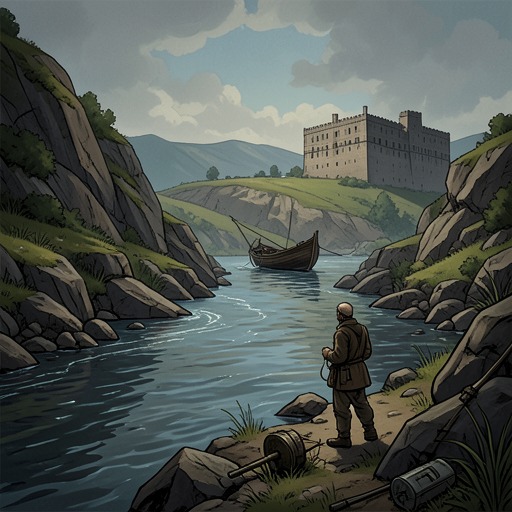
The Hulks lie within the geography of Pip’s childhood. The marsh country stretches toward the river and the sea, and the guns associated with the prison ships announce that prisoners have escaped. Their distant presence turns the marshes into a place of pursuit, where the authorities’ alarm can be heard even through mist.
A rough hut and landing place serve as a staging point for prisoners being transferred to a ship. Guards challenge the approaching party, a sergeant reports and records the arrival, and the prisoners are taken onward under guard. The setting makes the Hulks part of an organized custodial system, not merely a backdrop: movement between shore and ship is supervised, recorded, and enforced.
The Convict’s Transfer
After the capture of two escaped prisoners, one is separated from the other and taken to the ship first. Pip accompanies Joe, who carries a torch, as the party follows the river path to the landing. Once there, the other convict is sent aboard; Pip’s convict remains by the fire and says he wishes to clarify his part in the escape so that others will not be suspected.
At the water’s edge, a crew of convicts rows the boat. The prison ship is seen offshore, secured by heavy chains, and the prisoner is taken up its side and disappears from view. The torches are then extinguished. The transfer closes Pip’s first encounter with the convict as a child, while leaving the machinery of imprisonment and the convict’s future beyond the shore largely unseen.
Escape, Evidence, and Recapture
The Hulks remain a point of reference when guns signal that prisoners have escaped again. Later, Joe examines a filed convict’s leg-iron found beside Mrs. Joe after she has been attacked. Authorities connected with the prison ships confirm that the manacle once belonged to a prisoner, but that it was not worn by either of the two convicts who escaped that night. The evidence links the Hulks to the investigation without establishing who used the iron in the assault.
The convict’s later account connects the ships to the path from imprisonment to transportation. After being discharged, he undertakes to find the boy who once fed him and kept his secret, and to give him two one-pound notes. He explains that the boy had been tried again for prison breaking and made a lifer. The prison system thus persists beyond a single escape: one prisoner’s release and gratitude are set against another’s renewed sentence.
Transportation and the Law of Return
The convict eventually becomes a successful sheep-farmer and stock-breeder in New South Wales. Yet prosperity abroad does not erase his legal status. He tells Pip that he was transported for life and that returning to England means death; despite the danger, he has come to see Pip and says he does not intend to go back.
Mr. Jaggers confirms that he had warned the convict that he was exiled for the remainder of his life and that returning to England would be a felony punishable by the severest penalty. After the convict is captured, he is taken to court. His identity cannot immediately be established because the necessary former prison-ship officer is unavailable, but the eventual account at sentencing recalls his repeated imprisonment, escape, lifelong exile, return, and recapture. The court sentences him to death under the law governing his return.
The legal consequences extend to property. After the convict’s capture, his wealth is liable to forfeiture, and Pip has no recognized claim to it because no settlement was made in his favor before the arrest. The prison ships therefore belong to a wider structure of punishment: confinement and transportation are followed by continuing restrictions on identity, movement, life, and property, even after a convict has built a successful life overseas.
Narrative Significance
The Prison Hulks shape the novel’s contrast between apparent freedom and enduring legal exclusion. The convict’s life in New South Wales brings him wealth, but not the right to return; his voyage back to England converts gratitude toward Pip into a perilous act. The ships’ early appearance as a guarded destination thus foreshadows the later collision between the convict’s personal hopes and the state’s power to enforce exile.
They also link separate moments in Pip’s story. The childhood transfer establishes the convict’s vulnerability and the authorities’ control; the guns and filed iron bring the prison system back into the marshland plot; and the later trial reveals the full cost of return. The Hulks are both a concrete part of the novel’s penal landscape and the beginning of a longer chain of consequences that reaches from the river landing to the courtroom.